Synopsis: Learn how zero-based budgeting works and how to allocate every rupee of your monthly income. Explore practical examples, expense categories, savings strategies and the difference between zero-based budgeting and the 50/30/20 rule.
What Is Zero-Based Budgeting? A Practical Guide to Managing Your Money
Do you sometimes wonder where your monthly salary or business income disappears? You may earn a reasonable amount, pay your bills, manage household expenses and still find that very little money remains at the end of the month.
The problem is not always how much you earn. Sometimes, it is how you allocate and manage your income.
This is where Zero-Based Budgeting (ZBB) can help. It is a budgeting method in which you assign a specific purpose to every rupee you earn. Instead of spending first and saving whatever remains, you plan your income before spending it.
In this guide, we will explain how zero-based budgeting works, how to create a monthly budget in India and how this method can help you develop better financial habits.
What Is Zero-Based Budgeting?
Zero-based budgeting is a personal finance method in which your monthly income minus your planned expenses, savings and investments equals zero.
The formula is:
Monthly Income − Planned Expenses − Savings − Investments = ₹0
This does not mean you have to spend all your money. It means every rupee has an assigned purpose.
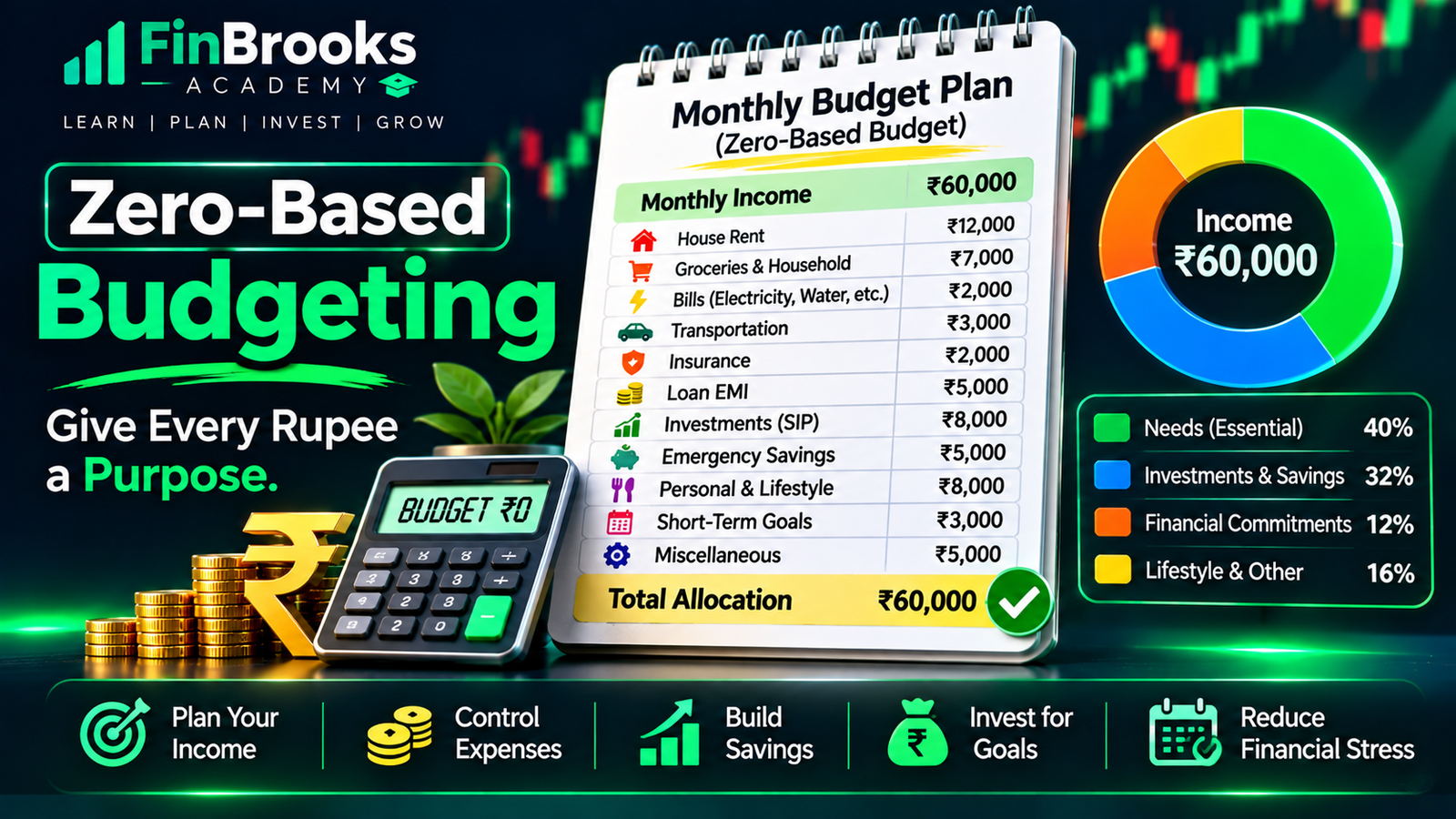
For example, if your monthly income is ₹60,000, you allocate the entire amount across household expenses, bills, savings, investments, insurance and personal spending.
Nothing is left unassigned.
The main objective is to make sure your money follows a financial plan instead of disappearing through unplanned purchases and unnecessary expenses.
How Does Zero-Based Budgeting Work?
Zero-based budgeting follows a simple process.
Step 1: Calculate Your Monthly Income
Start by calculating your total expected monthly income.
Include all regular and reasonably predictable income sources, such as:
- Monthly salary
- Business income
- Freelance earnings
- Rental income
- Other regular income
If your income changes every month, use a conservative estimate rather than assuming that you will earn your highest possible amount.
Step 2: List All Your Monthly Expenses
Write down every expense you expect to make during the month.
Divide them into categories such as:
Essential Expenses
- House rent or home loan EMI
- Groceries
- Electricity and water bills
- Transportation
- School fees
- Medical expenses
Financial Commitments
- Insurance premiums
- Loan repayments
- SIPs and investments
- Emergency fund contributions
- Other savings goals
Lifestyle Expenses
- Shopping
- Dining out
- Entertainment
- Subscriptions
- Travel and personal purchases
Step 3: Assign Money to Savings and Investments
Do not wait until the end of the month to decide how much you want to save.
Allocate money to your financial goals as soon as you prepare your budget.
For example, you may assign separate amounts to:
- Emergency savings
- Mutual fund SIPs
- Retirement investments
- Short-term financial goals
- Other planned investments
The amount should be realistic and consistent with your income and financial responsibilities.
Step 4: Allocate Money to Every Remaining Category
Once essential expenses and savings are planned, assign the remaining amount to discretionary spending and other categories.
If money is left unallocated, decide where it should go.
You could use it for additional savings, debt repayment, investments or a planned purchase.
Step 5: Track Your Actual Spending
A budget is useful only when you compare your planned expenses with your actual spending.
Record your transactions throughout the month.
If you spend more than planned in one category, adjust another category where possible rather than ignoring the difference.
Zero-Based Budgeting Example: Monthly Income of ₹60,000
Let’s understand this method through a practical example.
Suppose an individual earns ₹60,000 per month.
| Budget Category | Monthly Allocation |
|---|---|
| House Rent | ₹12,000 |
| Groceries and Household | ₹7,000 |
| Electricity and Bills | ₹2,000 |
| Transportation | ₹3,000 |
| Insurance | ₹2,000 |
| Loan EMI | ₹5,000 |
| Mutual Fund SIPs | ₹8,000 |
| Emergency Savings | ₹5,000 |
| Personal Expenses | ₹5,000 |
| Entertainment and Dining | ₹3,000 |
| Short-Term Savings | ₹3,000 |
| Miscellaneous Expenses | ₹5,000 |
| Total Allocation | ₹60,000 |
<text>In this example:</text>
- Monthly income: ₹60,000
- Total planned allocation: ₹60,000
- Unallocated amount: ₹0
Every rupee has a defined purpose.
These allocations are only illustrative. Your actual budget should reflect your income, household responsibilities, debts and financial priorities.
Zero-Based Budgeting vs 50/30/20 Budgeting
Both methods help individuals manage money, but they follow different approaches.
| Basis | Zero-Based Budgeting | 50/30/20 Budgeting |
|---|---|---|
| Main approach | Assign every rupee a purpose | Divide income into three broad categories |
| Expense planning | Detailed category-wise planning | Percentage-based allocation |
| Flexibility | Highly customised | Uses a general allocation guideline |
| Tracking | Requires regular monitoring | Relatively simple |
| Best suited for | Detailed financial control | People who prefer a simple budgeting structure |
Understanding the 50/30/20 Rule
Under the traditional 50/30/20 budgeting guideline:
- 50% of income goes towards needs.
- 30% goes towards wants.
- 20% goes towards savings and debt repayment.
For someone earning ₹60,000 per month, this would mean:
- Needs: ₹30,000
- Wants: ₹18,000
- Savings and debt repayment: ₹12,000
The 50/30/20 rule provides a broad framework, while zero-based budgeting allows you to plan every category individually.
You can even use the 50/30/20 rule as a starting point and then prepare a detailed zero-based budget.
Benefits of Zero-Based Budgeting
1. Better Control Over Expenses
When you assign a purpose to every rupee, you become more aware of where your money goes.
This can help reduce unnecessary spending and improve financial discipline.
2. Encourages Consistent Savings
Instead of saving whatever remains, you include savings in your monthly plan.
This makes it easier to work towards financial goals consistently.
3. Helps Identify Unnecessary Spending
Tracking expenses can reveal subscriptions, frequent food deliveries, impulse purchases and other costs that may be reduced.
4. Supports Debt Management
You can allocate a fixed amount towards loan repayments and additional debt reduction.
This helps you follow a structured repayment plan.
5. Makes Financial Goals More Practical
Whether you want to build an emergency fund, invest for retirement or save for a major purchase, zero-based budgeting helps convert broad goals into monthly allocations.
Common Mistakes to Avoid
Zero-based budgeting is effective when it reflects your actual financial situation. Avoid these common mistakes:
1. Forgetting Irregular Expenses
Annual insurance premiums, vehicle maintenance, festivals and medical expenses should also be included in your planning.
2. Setting Unrealistic Savings Targets
Do not allocate so much money to investments that you struggle to manage essential expenses.
3. Ignoring Small Purchases
Small daily purchases can add up over time. Track them instead of assuming they are insignificant.
4. Not Keeping a Miscellaneous Category
Unexpected small expenses can disturb your budget. Keep a reasonable allowance for them.
5. Treating the Budget as Fixed Forever
Your income, responsibilities and financial goals may change. Review your budget regularly and adjust the allocations.
How to Start Zero-Based Budgeting in India
You do not need expensive software or a complicated financial application to get started.
Follow this simple monthly routine:
- Calculate your expected monthly income.
- Review your previous month’s bank and UPI transactions.
- List your essential and discretionary expenses.
- Allocate money to savings and investments.
- Assign the remaining amount to other spending categories.
- Track expenses throughout the month.
- Review your budget at the end of the month.
You can use a simple spreadsheet, notebook or budgeting application to maintain your records.
The most important thing is consistency, not the tool you choose.
Conclusion
Zero-based budgeting is a practical way to take control of your monthly income. It changes the way you think about money by encouraging you to plan every rupee before spending it.
You do not need a very high income to follow this method. Whether you earn ₹25,000, ₹60,000 or ₹1 lakh per month, the same principle can help you allocate money more carefully.
Start with a simple monthly budget, track your expenses and adjust your allocations as your financial situation changes.
Remember, financial discipline is not just about earning more money. It is also about making better decisions with the money you already earn.
Disclaimer: This article is intended for educational purposes only. The examples and budget allocations are illustrative and should be adjusted according to individual financial circumstances.
Stay Ahead of the Market 📈
Subscribe to our weekly newsletter
Get your weekly market summary from FinBrooks Insights and smart financial lessons from FinBrooks Academy delivered straight to your inbox every weekend!