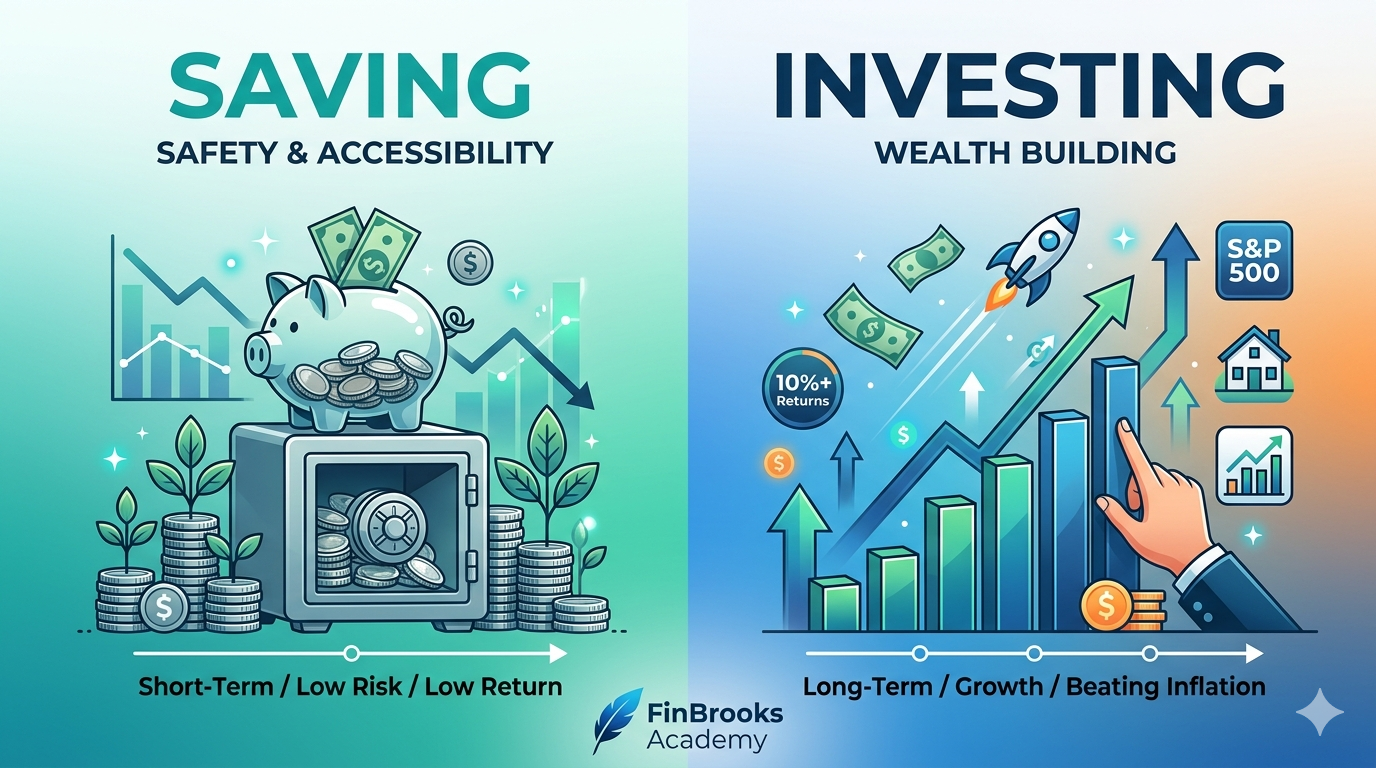
Beyond the Piggy Bank: Understanding the True Power of Wealth Creation
Since childhood, we’ve all been given one golden piece of financial advice—“Save your money!” From piggy banks to traditional savings accounts, putting money aside has become second nature to most of us. But can you actually build true wealth just by saving?
The short answer is: No.
In today’s world, if you want to achieve your long-term financial dreams, you must understand the critical difference between Saving and Investing. Let’s break it down in plain English.
1. What is Saving?
Saving means setting aside a portion of your income that you do not spend on current expenses. This money is kept in safe, easily accessible places so you can grab it the moment you need it (this is called High Liquidity).
- Where do people save? Standard savings accounts, certificates of deposit (CDs), high-yield savings accounts, or traditional fixed deposits (FDs).
- Why do people save? For emergency funds, unexpected medical bills, or short-term goals (like buying a laptop next month).
The Biggest Benefit: Near-zero risk. Your principal amount is completely secure.
The Biggest Downside: The interest rates are very low (usually 1% to 4%), which means your money doesn’t grow much.
2. What is Investing?
Investing means taking the money you’ve saved and putting it into financial assets with the expectation that it will generate a profit over time. In simple terms, it is putting your money to work so it makes more money.
- Where do people invest? Stocks, Mutual Funds, Exchange-Traded Funds (ETFs), Real Estate, or Gold.
- Why do people invest? To build long-term wealth, beat inflation, buy a house, or fund a comfortable retirement.
The Biggest Benefit: The potential for much higher returns (historically 8% to 12%+ over the long run).
The Biggest Downside: There is inherent market risk. The value of your investments can go up and down in the short term.
A Real-World Example: Meet Alex and Sam
Imagine two friends, Alex and Sam. Both manage to save $1,000 this year.
- Alex chooses Saving: He leaves his $1,000 in a standard savings account earning a 2% interest rate. After 5 years, his money grows to about $1,104.
- Sam chooses Investing: He invests his $1,000 into a diversified Mutual Fund that tracks the stock market, earning an average return of 10%. After 5 years, his money grows to roughly $1,610!
Enter the Silent Killer: Inflation
Inflation is the rising cost of goods over time. If a basket of groceries costs $1,000 today, it might cost $1,150 in five years due to inflation. Because Alex only saved, his money actually lost purchasing power—he can no longer afford that same basket of groceries. Sam’s invested money, however, easily outpaced inflation, growing his real wealth.
Quick Summary: Saving vs. Investing
Let’s look at the core differences side-by-side:
| Feature | Saving | Investing |
| Main Goal | Keeping money safe and accessible | Growing money and building wealth |
| Risk Level | Negligible / Very Low | Medium to High (depends on the asset) |
| Expected Returns | Low (typically 1% – 4%) | Higher Potential (typically 8% – 12%+) |
| Time Horizon | Short-term (0 to 2 years) | Long-term (5 years or more) |
| Liquidity | Extremely High (Instant access) | Moderate to High (Can take a few days to withdraw) |
FinBrooks Reality Check 💡
Which one should you choose?
You need both! A healthy financial life requires balance.
Your first step should always be to Save an emergency fund worth 3 to 6 months of your living expenses so you are protected against life’s surprises. Once that safety net is built, any extra money should be Invested into assets like stocks or mutual funds according to your goals.
Remember: Saving protects you from today’s emergencies, but Investing builds the future you deserve.
Stay Ahead of the Market 📈
Subscribe to our weekly newsletter
Get your weekly market summary from FinBrooks Insights and smart financial lessons from FinBrooks Academy delivered straight to your inbox every weekend!