Don’t Wait for the ‘Perfect’ Time: Start Your Investment Journey Now to Reap Massive Rewards
For many young professionals in their 20s, the idea of investing can feel intimidating, irrelevant, or simply a task for ‘later.’ You’re focused on building a career, enjoying social life, or navigating early adulthood. It’s a common misconception that wealth creation is a sprint to be run in your 30s or 40s.
However, the reality is that the single most powerful tool for building substantial wealth isn’t a massive salary or lucky stock picks—it’s time. Your 20s are not for procrastination; they are for harnessing the incredible power of time to secure your financial future. Let’s explore why starting early is the ultimate wealth multiplier and why starting now is your single smartest decision.
The Phenomenal Magic of Compounding Interest
Albert Einstein reportedly called compound interest the ‘eighth wonder of the world.’ It’s a concept that sounds simple, but its exponential effect over time is nothing short of magical.
- Simple Interest: Interest is calculated only on your principal amount. If you invest ₹10,000 at 10% annual simple interest, you earn ₹1,000 every year.
- Compound Interest: Interest is calculated on your principal amount PLUS all previously accumulated interest. If you invest ₹10,000 at 10% annual compound interest, in the first year you earn ₹1,000. In the second year, you earn 10% of ₹11,000, and so on.
The longer your money has to compound, the larger your returns become, eventually dwarfing your initial contribution. Your 20s give you an unmatched 30 to 40-year runway, allowing compounding to do the heavy lifting for you.
The Early Bird Advantage: A Real-World Indian Example
Let’s illustrate the immense difference time makes with a simple comparison using an Indian context and mutual funds.
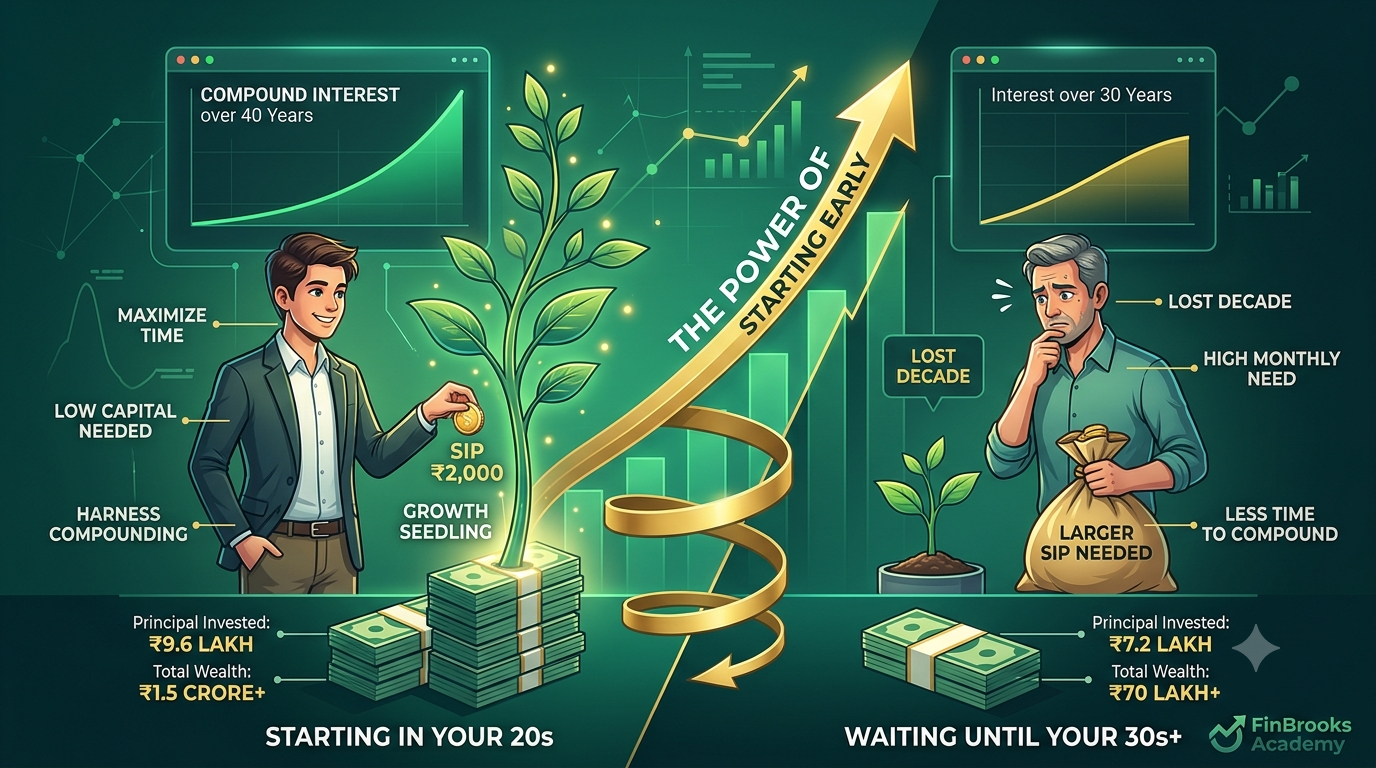
- Maya starts investing ₹2,000 per month at age 22 in a mutual fund with an average annual return of 12%.
- Alex waits until age 32 to start investing ₹2,000 per month in the same fund.
Assuming a fixed annual return of 12% for simplicity, let’s see their portfolio values at age 62:
| Investor | Starts at Age | Total Amount Invested (₹) | Total Principal | Total Wealth Created (₹) | Total Multiplier |
| Maya | 22 | ₹9,60,000 | ₹24,000/yr for 40 years | ₹1.5 CRORE+ | ~16x Principal |
| Alex | 32 | ₹7,20,000 | ₹24,000/yr for 30 years | ₹70 LAKH+ | ~10x Principal |
Maya, by starting just 10 years earlier, will have more than DOUBLE the wealth of Alex at age 62, even though she invested only one-third of the total amount of money Alex did. The first ten years of Maya’s early compounding created a momentum that Alex could never catch up to.
Essential Steps to Start in Your 20s
- Build a Small Emergency Fund: Start with an initial buffer of ₹50,000 to ₹1 Lakh in a savings account or a liquid fund for truly unpredictable emergencies, so you don’t have to break your long-term investments.
- Automate Your Investments (SIP): Create a Systematic Investment Plan (SIP) from day one of your first job. Automating it keeps you consistent.
- Keep Your Expenses Capped: Resist lifestyle inflation as your income increases. Enjoy your hard-earned salary, but prioritize saving and investing a fixed percentage first.
- Learn the Basics: Don’t chase trends or tips. Understand your risk tolerance, asset allocation, and low-cost index funds.
FinBrooks Reality Check
You don’t need a massive income to build substantial wealth; you simply need to start early and remain consistent. Your 20s are the absolute prime season of your financial life—do not waste them.
Even a small SIP of ₹1,000 per month in a Nifty 50 index fund, started as early as possible, is infinitely better than waiting ‘until you have more money.’ Let time be your greatest asset, automate your contributions, and let the eighth wonder of the world do its magic for you.
Stay Ahead of the Market 📈
Subscribe to our weekly newsletter
Get your weekly market summary from FinBrooks Insights and smart financial lessons from FinBrooks Academy delivered straight to your inbox every weekend!