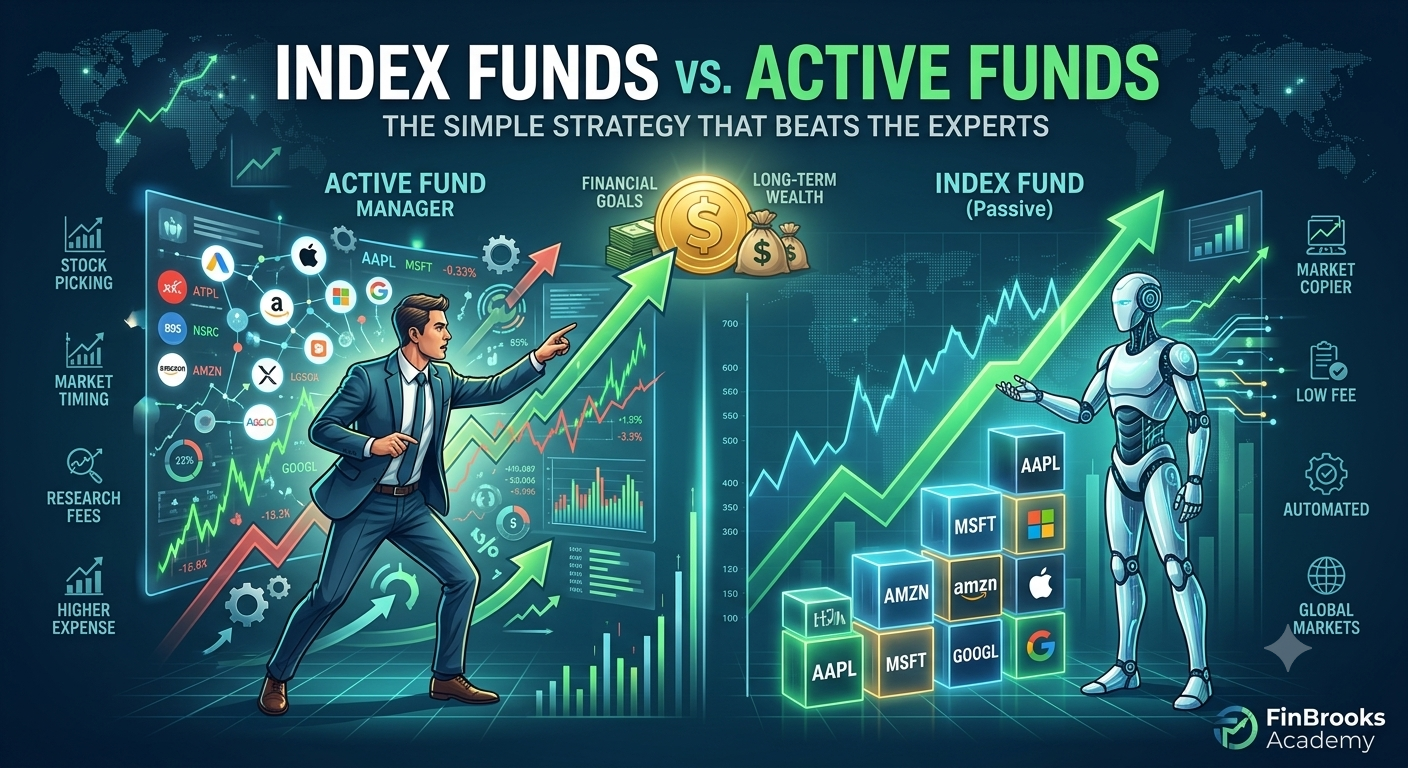
Passive Power vs. Active Hunting: Unlocking the Smartest Way to Own the Market
When you enter the world of stock market investing, one of the biggest decisions you will face is choosing how your money is managed. Should you hire a high-profile fund manager who actively picks individual stocks to try and beat the market? Or should you take the automated route and simply buy an entire index that tracks the market’s overall performance?
This debate, Active Stock Picking versus Passive Indexing has generated endless discussions on Wall Street and main street alike. While active fund managers promise outsized profits, historical data shows a surprisingly different reality. Let us break down how both strategies work so you can choose the right engine for your long-term wealth.
What is an Active Mutual Fund?
An actively managed fund is run by a professional fund manager backed by a team of research analysts. Their main goal is to beat the broader market benchmark (like the Nifty 50 or the S&P 500).
To achieve this, the manager constantly buys and sells individual stocks based on market trends, company earnings reports, and economic forecasts. Because it requires heavy research, constant monitoring, and frequent trading, active funds charge a higher management fee (Expense Ratio) to pay for this expert labor.
What is an Index Fund (Passive Investing)?
An index fund takes human emotion and guesswork completely out of the equation. Instead of trying to pick winning individual stocks, an index fund simply copies a specific stock market index. For example, a Nifty 50 Index Fund buys all 50 companies in the exact same proportion as the index itself.
Think of an index fund like buying the entire fruit basket instead of trying to guess which single apple inside will taste the sweetest. Because there is no team of expensive stock pickers running the fund, the management fees are remarkably close to zero.
The Great Performance Paradox
Common sense tells us that paying a professional expert should yield better results than an automated computer program. Surprisingly, in the world of finance, the opposite is often true over long periods.
Data consistently shows that over a 10-to-15-year horizon, roughly 80% to 90% of actively managed funds fail to beat a simple, low-cost index fund. Why? Because the high management fees charged by active managers create a heavy drag on returns. To beat the index, an active manager doesn’t just have to outperform the market; they have to outperform the market plus cover their own expensive fees every single year.
Strategy Comparison at a Glance
| Feature | Active Mutual Funds | Index Funds (Passive) |
| Primary Goal | Outperform/beat the market index | Match the exact market index performance |
| Human Decision Making | High (Manager picks individual stocks) | Zero (Automated rule-based tracking) |
| Annual Fees (Expense Ratio) | Higher (Typically 1.0% to 2.0%) | Ultra-low (Typically 0.05% to 0.2%) |
| Human Error Risk | High (Manager can make wrong stock calls) | Zero (Eliminates manager risk) |
| Best Suited For | Niche, high-growth, or inefficient sectors | Core long-term portfolio building |
FinBrooks Reality Check
Investing does not need to be complicated or stressful to be successful. Legendary investor Warren Buffett has famously advised that for most everyday investors, consistently buying a low cost S&P 500 or market index fund is the single most reliable way to build wealth over time.
If you are just starting out, keep your core portfolio simple. Build a strong foundation using low cost Index Funds, and only venture into active funds if you are specifically targeting high risk, high reward sectors where active stock selection truly adds value.
Stay Ahead of the Market 📈
Subscribe to our weekly newsletter
Get your weekly market summary from FinBrooks Insights and smart financial lessons from FinBrooks Academy delivered straight to your inbox every weekend!