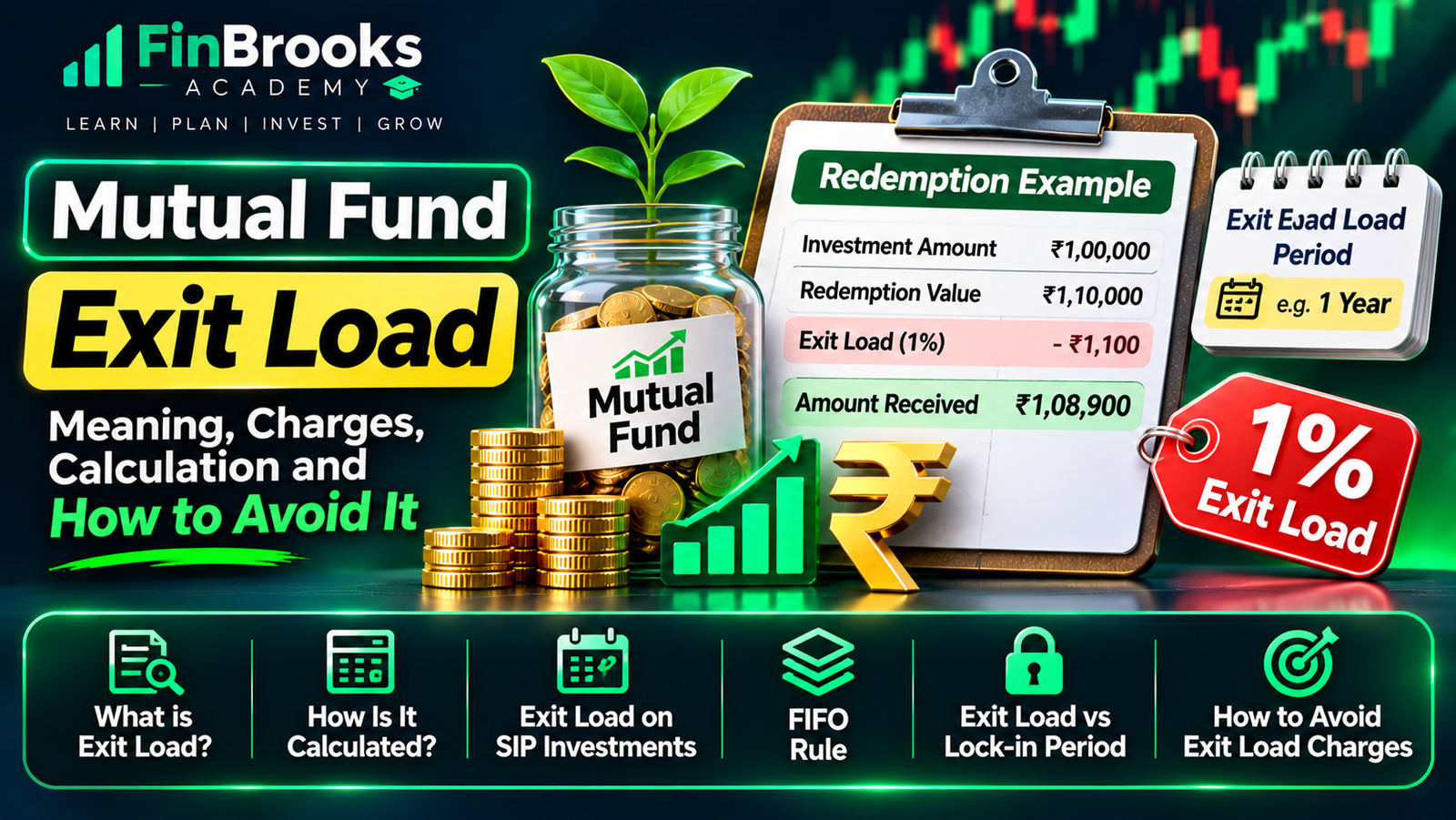
What is exit load in mutual funds, and how can it affect your returns? Learn how exit load is calculated, how SIP instalments are treated, the difference between exit load and lock-in periods, and how to avoid unnecessary redemption charges.
What Is Exit Load in Mutual Funds? A Complete Guide for Investors
Investing in mutual funds is not just about selecting the right scheme and earning returns. Investors should also understand the charges that may apply when they withdraw their money.
One such charge is called Exit Load.
Many investors focus on a mutual fund’s returns but overlook the exit load applicable when redeeming their units. If you withdraw your investment before the specified period, the fund may deduct an exit load from the redemption value.
Understanding exit load can help you plan withdrawals, avoid unnecessary costs and make better mutual fund investment decisions.
What Is Exit Load in Mutual Funds?
Exit load is a fee charged by an Asset Management Company (AMC) when an investor redeems or withdraws mutual fund units before a specified period.
This period is generally known as the exit load period or holding period.
The exit load is usually calculated as a percentage of the applicable redemption value, according to the scheme’s terms.
For example, suppose you invest ₹50,000 in a mutual fund scheme that has a 1% exit load if units are redeemed within one year.
If you redeem the investment during the applicable exit load period, the fund may deduct the specified charge from the redemption amount.
However, exit load is not applicable to every mutual fund scheme. Its percentage, conditions and applicable period depend on the individual scheme.
Why Do Mutual Funds Charge Exit Load?
Exit load is designed to discourage very short-term withdrawals and help maintain stability in a mutual fund scheme.
When investors frequently redeem their investments, the fund may need to sell underlying securities to meet redemption requests.
This can create transaction costs and affect the management of the scheme.
Exit load can help discourage unnecessary short-term trading and protect the interests of long-term investors.
However, the primary purpose and structure of the exit load must be understood from the scheme’s offer documents.
How Does Exit Load Work?
Let’s understand exit load through a simple example.
Suppose you invest ₹1,00,000 in a mutual fund scheme with the following conditions:
- Investment amount: ₹1,00,000
- Exit load: 1%
- Exit load period: 12 months
- Redemption value within the applicable period: ₹1,10,000
If you redeem the units while the 1% exit load applies:
| Particulars | Amount |
|---|---|
| Redemption Value | ₹1,10,000 |
| Exit Load Rate | 1% |
| Exit Load Deducted | ₹1,100 |
| Amount Payable | ₹1,08,900 |
In this example, the exit load is ₹1,100, and the investor receives ₹1,08,900 before any other applicable deductions or taxes.
The example is illustrative. Actual calculations depend on the scheme’s exit load terms and the applicable redemption value.
Does Every Mutual Fund Have an Exit Load?
No. Exit load varies from one mutual fund scheme to another.
Some schemes may have an exit load for a specified period, while others may have no exit load.
Different schemes can also have different rates and redemption conditions.
For example:
| Mutual Fund Category | Exit Load |
|---|---|
| Equity Mutual Funds | Depends on the individual scheme |
| Debt Mutual Funds | Depends on the individual scheme |
| Liquid Funds | May have a graded exit load for a specified initial period |
| Overnight Funds | Generally designed for very short-term liquidity; check scheme terms |
| Index Funds | Depends on the individual scheme |
| ELSS Funds | Redemption is subject to a three-year lock-in |
Important: These are category-level explanations, not fixed exit load rules. Always check the latest scheme information document before investing or redeeming.
What Is the Difference Between Exit Load and Lock-in Period?
Exit load and lock-in period are two different concepts.
An exit load is a charge that may apply when you redeem units during a specified period.
A lock-in period restricts you from redeeming your investment before a specified date.
For example, Equity Linked Savings Schemes (ELSS) generally have a three-year lock-in period for each investment.
You cannot normally redeem an ELSS investment before the applicable lock-in period ends, even if you are willing to pay an exit load.
| Basis | Exit Load | Lock-in Period |
|---|---|---|
| Meaning | Charge on eligible early redemption | Restriction on redemption |
| Main purpose | Discourages short-term withdrawals | Restricts premature withdrawal |
| Early withdrawal | May be allowed with a charge | Generally not permitted |
| Example | 1% exit load during a specified period | Three-year ELSS lock-in |
Understanding this difference is important when selecting mutual funds for short-term and long-term financial goals.
How Is Exit Load Calculated on SIP Investments?
A Systematic Investment Plan (SIP) involves purchasing mutual fund units at different dates.
Therefore, each SIP instalment has its own investment date and holding period.
Exit load is generally calculated separately for the units being redeemed, based on the scheme’s applicable terms.
Example of SIP Exit Load
Suppose you invest ₹5,000 every month in a mutual fund scheme with a 1% exit load on units redeemed within one year.
You have made the following investments:
| SIP Instalment | Investment Date | Amount |
|---|---|---|
| First Instalment | January | ₹5,000 |
| Second Instalment | February | ₹5,000 |
| Third Instalment | March | ₹5,000 |
If you redeem units in September, the holding period of each instalment will be different.
Some units may fall within the exit load period, while others may be subject to different conditions depending on the scheme.
This is why an investor should not assume that the entire SIP investment has completed one year simply because the SIP started more than a year ago.
Mutual funds generally follow the First-In-First-Out (FIFO) method when determining which units are redeemed first.
What Is the FIFO Rule in Mutual Funds?
FIFO stands for First-In-First-Out.
Under this method, the oldest units are considered redeemed first when an investor makes a redemption request from a particular mutual fund folio and scheme.
For example:
- January investment: 100 units
- February investment: 100 units
- March investment: 100 units
If you redeem 150 units, the first 100 units from January and the next 50 units from February are generally considered redeemed.
This matters because the holding period and applicable exit load can differ between investment instalments.
How Can You Check the Exit Load Before Investing?
Before investing in a mutual fund, check the scheme’s exit load conditions.
You can find this information in:
- Scheme Information Document (SID).
- Key Information Memorandum (KIM).
- AMC’s official mutual fund scheme page.
- Mutual fund factsheets.
- Your investment platform’s scheme details.
Pay attention to:
- Exit load percentage.
- Applicable holding period.
- Whether the rule applies to all units or only specified redemptions.
- Any permitted free redemption limits.
- Special conditions for systematic transactions.
Do not rely only on the exit load displayed on an investment app. Review the official scheme documents whenever the details are important to your decision.
How to Avoid Unnecessary Exit Load Charges
You can reduce the possibility of paying exit load by following a few practical steps.
1. Understand the Exit Load Period
Before investing, check how long the exit load applies.
2. Plan Your Investment Horizon
Choose a mutual fund scheme according to your financial goal and expected withdrawal date.
3. Check Each SIP Instalment
Remember that different SIP instalments have different investment dates and holding periods.
4. Check Free Redemption Limits
Some schemes may permit redemption of a specified portion of units without an exit load, subject to scheme conditions.
5. Review Before Redeeming
Check the applicable exit load on the units you plan to redeem before submitting the transaction.
Do not delay an essential financial withdrawal only to avoid an exit load. Consider the overall financial situation and the cost of remaining invested.
Exit Load vs Expense Ratio: What Is the Difference?
Both exit load and expense ratio are mutual fund-related costs, but they work differently.
| Basis | Exit Load | Expense Ratio |
|---|---|---|
| Meaning | Charge on eligible redemption | Annual scheme operating expense |
| When applicable | At the time of eligible redemption | Reflected in the scheme’s NAV |
| Calculation | Based on applicable redemption value | Based on scheme assets and applicable rate |
| Purpose | Discourages specified early withdrawals | Covers scheme management and operating expenses |
Investors should understand both costs while comparing mutual fund schemes.
Conclusion
Exit load is an important factor to consider before investing in mutual funds. It can reduce the amount you receive when redeeming units during the applicable period.
However, exit load should not be the only factor when selecting a mutual fund. Investors should also evaluate the scheme’s investment objective, risk level, portfolio, performance and suitability for their financial goals.
Before making a redemption request, check the applicable exit load on your units, especially if you invest through SIPs.
A little attention to these details can help you avoid unnecessary costs and manage your mutual fund investments more effectively.
Disclaimer: This article is for educational purposes only. Exit load rates, holding periods and redemption conditions vary by mutual fund scheme and may change. Always refer to the latest official scheme documents before making an investment or redemption decision.
Stay Ahead of the Market 📈
Subscribe to our weekly newsletter
Get your weekly market summary from FinBrooks Insights and smart financial lessons from FinBrooks Academy delivered straight to your inbox every weekend!