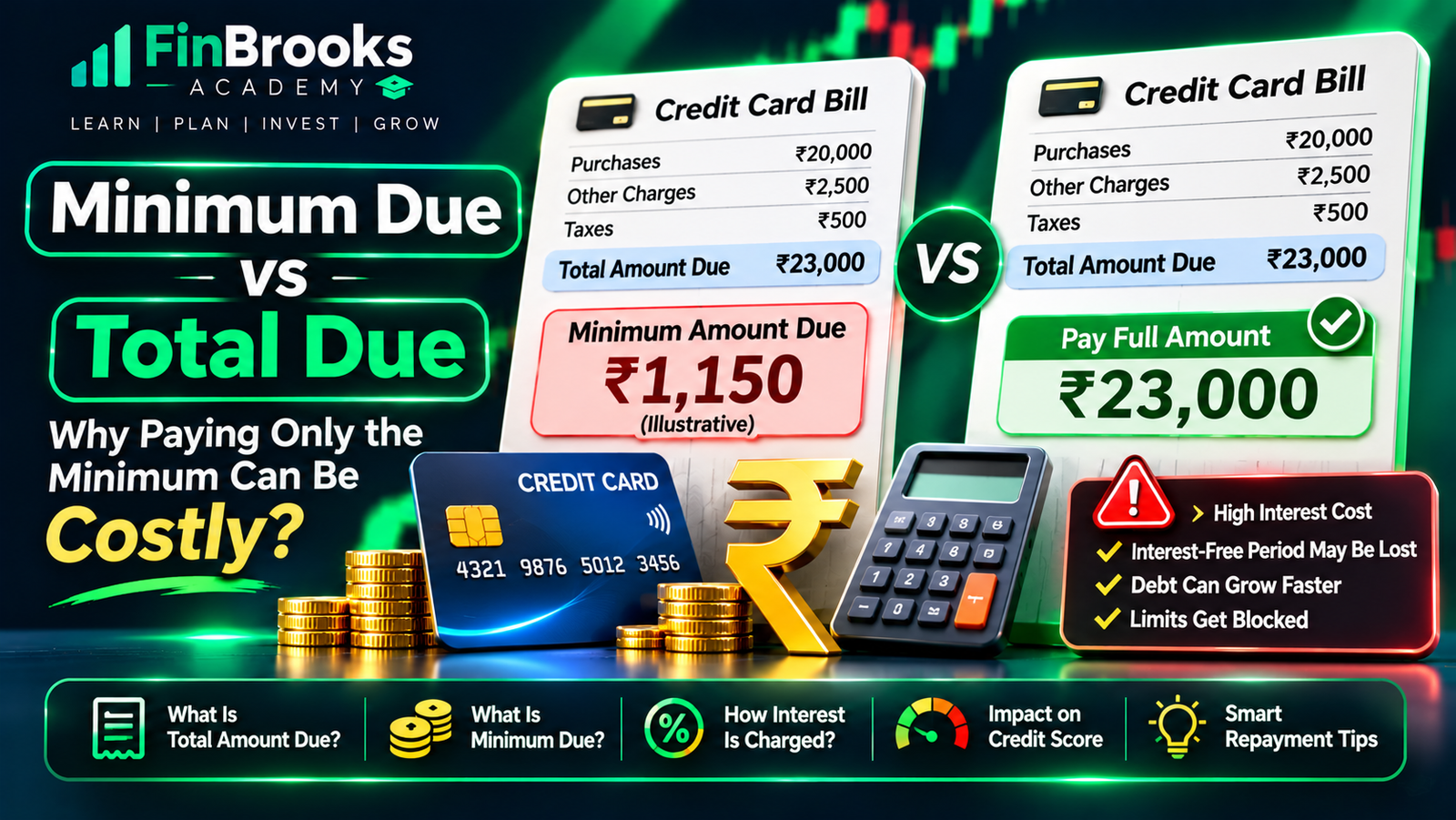
Synopsis: Understand the difference between credit card minimum amount due and total amount due. Learn how interest is charged on unpaid balances, how minimum payments affect your finances and why clearing your full credit card bill is usually the smarter choice.
Credit Card Minimum Amount Due vs Total Amount Due: Understanding the Difference
Credit cards offer convenience, purchasing flexibility and access to short-term credit. However, many cardholders make a costly mistake when paying their monthly credit card bills: they pay only the minimum amount due instead of clearing the total outstanding amount.
At first glance, paying the minimum amount may seem like a smart way to manage monthly expenses. Your payment is accepted, your account may remain regular for billing purposes, and you avoid paying the entire bill immediately.
But there is an important catch. The unpaid balance can attract substantial interest and additional charges, making your purchases significantly more expensive over time.
Understanding the difference between the minimum amount due and the total amount due is essential for responsible credit card management.
What Is the Total Amount Due on a Credit Card?
The total amount due is the complete amount payable against your credit card statement by the payment due date.
It generally includes:
- Purchases made during the billing cycle
- Applicable fees and charges
- Interest or finance charges already added
- Taxes on applicable charges
- Previous unpaid balances, if any
For example, suppose your monthly credit card statement shows:
| Particulars | Amount |
|---|---|
| Shopping purchases | ₹12,000 |
| Grocery expenses | ₹5,000 |
| Online subscriptions | ₹2,000 |
| Other purchases | ₹6,000 |
| Total Amount Due | ₹25,000 |
In this example, ₹25,000 is the total amount you need to pay to clear the statement balance, assuming there are no subsequent adjustments.
What Is the Minimum Amount Due?
The minimum amount due is the smallest payment specified by your credit card issuer that you must pay by the due date to avoid being treated as having missed the minimum payment obligation.
It is usually calculated using a percentage of the outstanding balance, along with applicable components such as fees, taxes, interest and instalment amounts. The exact calculation varies between card issuers and card products.
For example:
| Particulars | Amount |
|---|---|
| Total Amount Due | ₹25,000 |
| Illustrative Minimum Amount Due | ₹1,250 |
If your statement shows ₹1,250 as the minimum amount due, paying this amount fulfils the minimum payment requirement for that billing cycle.
However, the remaining ₹23,750 does not disappear. It remains unpaid and may attract finance charges according to your card’s terms and conditions.
Minimum Amount Due vs Total Amount Due
Understanding this difference can help you avoid unnecessary credit card interest.
| Basis | Minimum Amount Due | Total Amount Due |
|---|---|---|
| Meaning | Smallest required payment | Complete statement balance |
| Payment amount | Usually a portion of the bill | Entire amount payable |
| Interest on remaining balance | Generally applicable | Normally avoided on the cleared statement balance |
| Credit card balance | Remains partly unpaid | Statement balance is cleared |
| Long-term cost | Can become expensive | Usually the more cost-effective option |
The key point is simple: paying the minimum amount due is not the same as clearing your credit card bill.
What Happens If You Pay Only the Minimum Amount Due?
Paying only the minimum amount due can create several financial problems.
1. Interest Is Charged on the Unpaid Balance
When you do not clear the full statement balance, the remaining amount generally attracts finance charges.
Credit card interest rates can be significantly higher than those of many conventional loans.
The applicable rate depends on your card issuer and card agreement.
2. You May Lose the Interest-Free Period
Many credit cards offer an interest-free period on eligible purchases when the previous statement balance is paid in full by the due date.
If you carry an unpaid balance, the interest-free benefit on new purchases may be withdrawn under the card’s terms.
This means even new purchases can become more expensive.
3. Your Outstanding Balance Can Increase
Interest, applicable fees and taxes may add to your outstanding balance.
If you continue making new purchases while paying only the minimum, your total debt can become difficult to manage.
4. Your Available Credit Limit Gets Reduced
Unpaid balances continue to occupy your available credit limit.
For example, if your credit limit is ₹1,00,000 and your outstanding balance is ₹60,000, your available limit may be approximately ₹40,000, subject to other pending transactions and adjustments.
Example: How Expensive Can Minimum Payments Become?
Let’s understand the impact through a simplified example.
Suppose:
- Credit card outstanding balance: ₹50,000
- Illustrative monthly interest rate: 3.5%
- Minimum payment: ₹2,500
- No additional purchases during the example period
If you pay only ₹2,500, the remaining balance is ₹47,500 before accounting for subsequent interest and other charges.
At an illustrative monthly interest rate of 3.5%, the interest on ₹47,500 for one month would be approximately ₹1,662.50, before applicable taxes and any issuer-specific calculations.
This means a substantial portion of your payment may be offset by interest charges.
Actual credit card interest is generally calculated using the issuer’s billing methodology, transaction dates, payment dates and applicable terms. This example is only an illustration, not an exact repayment schedule.
Does Paying Only the Minimum Amount Due Affect Your Credit Score?
Paying at least the minimum amount due by the payment deadline generally helps you avoid being reported as having missed that minimum payment obligation.
However, this does not mean that paying only the minimum is always good for your credit profile.
A high outstanding balance relative to your available credit limit can increase your credit utilisation ratio.
For example:
| Particulars | Amount |
|---|---|
| Credit Limit | ₹1,00,000 |
| Outstanding Balance | ₹70,000 |
| Credit Utilisation | 70% |
A high utilisation ratio may negatively affect your credit score, depending on the scoring model and your overall credit history.
For better credit management, try to keep your outstanding balance under control and pay your statement balance in full whenever possible.
What Is the Best Way to Pay Your Credit Card Bill?
The most financially sensible approach for most cardholders is to pay the total amount due by the payment due date.
Follow these practices:
1. Pay the Full Statement Balance
Avoid treating the minimum amount due as your regular monthly payment target.
2. Set Payment Reminders
Set reminders a few days before the due date to avoid accidental delays.
3. Avoid Spending Beyond Your Repayment Capacity
A credit card should support your planned spending, not encourage unnecessary borrowing.
4. Track Every Transaction
Review your monthly statement and check for unfamiliar transactions, subscriptions and additional charges.
5. Avoid Cash Withdrawals Using Credit Cards
Cash advances can attract separate fees and interest, often from the date of withdrawal. Check your card terms before using this facility.
What If You Cannot Pay the Full Credit Card Bill?
Sometimes, unexpected expenses or financial difficulties can make it difficult to clear the entire statement balance.
In such situations:
- Pay at least the required minimum amount by the due date if possible.
- Stop unnecessary new credit card spending.
- Contact your card issuer and ask about available repayment or EMI conversion options.
- Compare the total interest, fees and repayment period before accepting a conversion offer.
- Prioritise clearing expensive outstanding credit card debt.
Remember that converting outstanding balances into EMIs may involve interest and additional charges. Review the terms carefully.
Conclusion
The difference between minimum amount due and total amount due is one of the most important things every credit card user should understand.
Paying only the minimum amount may help you meet the minimum payment requirement, but it does not clear your debt. The remaining balance can attract interest, reduce your available credit limit and make future purchases more expensive.
Whenever possible, pay your complete statement balance by the due date. Use your credit card as a payment convenience rather than a source of long-term borrowing.
Disclaimer: This article is for educational purposes only. Credit card interest rates, minimum payment calculations, fees and repayment conditions vary between banks and card issuers. Always read your card’s terms and conditions.
Stay Ahead of the Market 📈
Subscribe to our weekly newsletter
Get your weekly market summary from FinBrooks Insights and smart financial lessons from FinBrooks Academy delivered straight to your inbox every weekend!