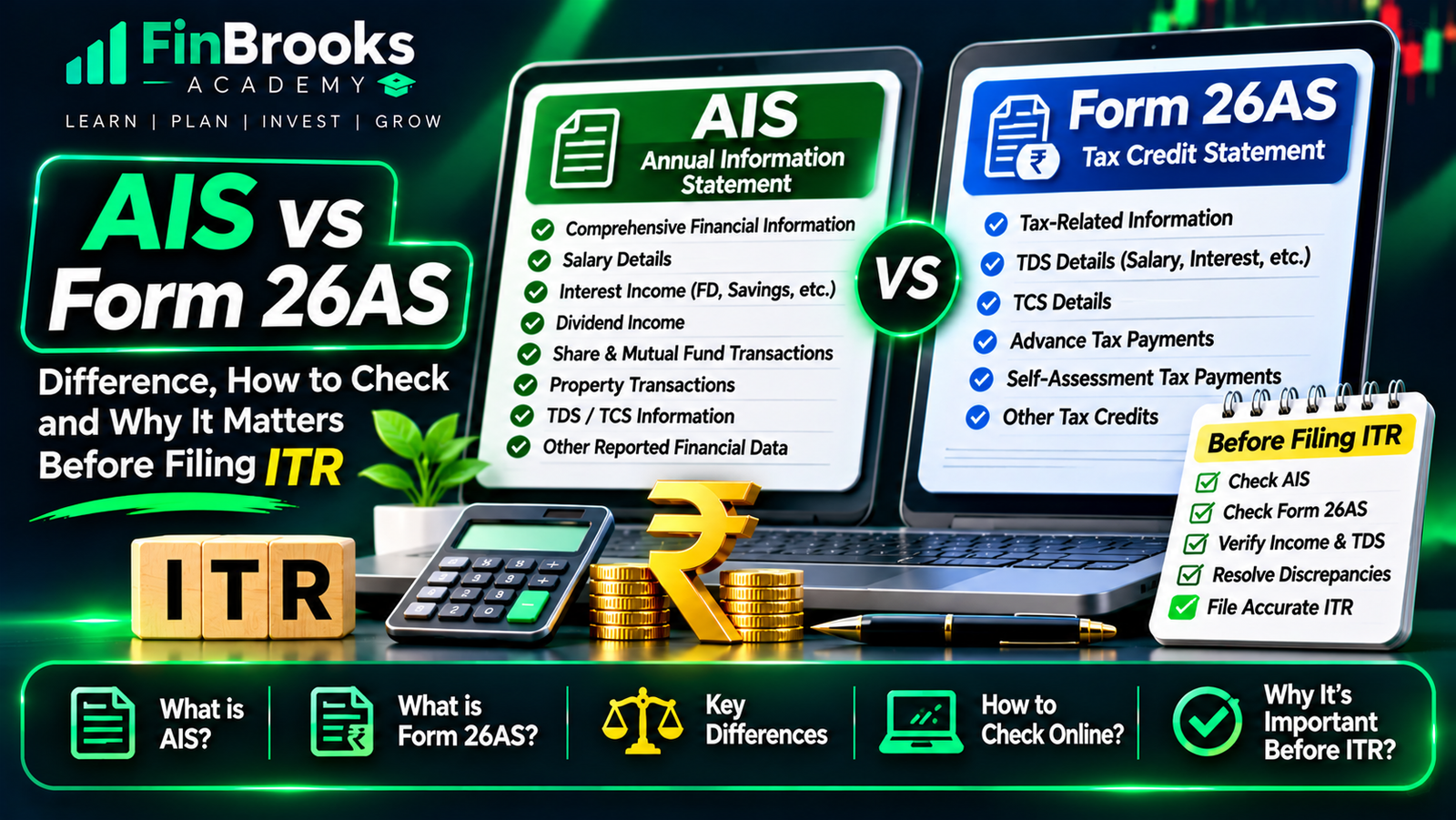
AIS and Form 26AS are important documents to check before filing your ITR. Learn their differences, what information they contain, how to access them online and how to identify discrepancies in your income tax records.
AIS vs Form 26AS: Understanding Your Income Tax Records
Filing an Income Tax Return (ITR) involves more than simply entering your salary, deductions and bank details. Before submitting your tax return, it is important to review the financial information available in your income tax records.
Two important documents that taxpayers should check are the Annual Information Statement (AIS) and Form 26AS.
Both documents provide information related to financial transactions and tax records. However, they serve different purposes and contain different types of information.
Understanding the difference between AIS and Form 26AS can help you identify discrepancies, verify tax deductions and avoid errors while filing your Income Tax Return.
What Is AIS (Annual Information Statement)?
The Annual Information Statement (AIS) is a comprehensive statement of financial information available to the Income Tax Department for a taxpayer.
It provides information about various financial transactions and income-related details reported by different entities.
AIS helps taxpayers review financial information that may be relevant while preparing their Income Tax Return.
What Information Is Available in AIS?
AIS may contain information related to:
- Salary-related information.
- Interest income from banks and financial institutions.
- Dividend income.
- Securities transactions.
- Mutual fund transactions.
- Property-related transactions reported to the tax department.
- Tax deducted at source (TDS).
- Tax collected at source (TCS).
- Other financial information reported by specified entities.
The information available in AIS depends on the transactions reported by different financial institutions, businesses and other reporting entities.
What Is Form 26AS?
Form 26AS is a tax statement that helps taxpayers review important tax-related information associated with their PAN.
It is particularly useful for checking tax deducted at source (TDS), tax collected at source (TCS), tax payments and other relevant tax information reflected in the statement.
Taxpayers can use Form 26AS to verify whether tax deductions and tax payments have been correctly reflected in their tax records.
What Information Is Available in Form 26AS?
Depending on the applicable reporting framework, Form 26AS may contain information related to:
- Tax deducted at source (TDS).
- Tax collected at source (TCS).
- Advance tax payments.
- Self-assessment tax payments.
- Certain tax-related transactions and information.
Taxpayers should also review AIS because it provides broader financial transaction information.
AIS vs Form 26AS: Key Differences
| Basis | AIS | Form 26AS |
|---|---|---|
| Full Form | Annual Information Statement | Tax Credit Statement |
| Main Purpose | Provides broader financial information | Provides tax-related information and tax credit details |
| Information | Income, transactions, TDS/TCS and other reported information | TDS, TCS, tax payments and other applicable tax information |
| Financial Transactions | More comprehensive financial transaction information | Generally more focused on tax-related records |
| Use Before ITR | Helps verify income and financial transactions | Helps verify tax credits and tax payments |
| Feedback Facility | Taxpayer can provide feedback on reported information | Primarily used for checking tax-related records |
AIS and Form 26AS should not be treated as substitutes for each other. Reviewing both can help taxpayers prepare a more accurate Income Tax Return.
Why Should You Check AIS Before Filing ITR?
AIS can help you identify financial information that you may otherwise overlook while filing your Income Tax Return.
1. Verify Your Interest Income
Interest earned from savings accounts, fixed deposits and other financial instruments may be reported in AIS.
If you have multiple bank accounts or deposits, reviewing AIS can help you identify interest income that needs to be considered in your tax calculation.
2. Check Dividend Income
Dividend income from shares and mutual funds may be reported in your financial information.
Reviewing AIS can help you identify dividend transactions and ensure that relevant income is considered while preparing your tax return.
3. Review Share and Mutual Fund Transactions
AIS may contain information about securities and mutual fund transactions reported by relevant entities.
This can help taxpayers review their investment-related transactions before calculating capital gains or other applicable tax information.
However, AIS transaction details should not automatically be treated as the final capital gains calculation. Investors should use appropriate transaction records and statements to calculate their actual tax liability.
4. Identify Unexpected Transactions
If AIS contains information that you do not recognise, you should investigate it.
Possible reasons may include:
- Incorrect reporting.
- Transactions reported under your PAN.
- Data entry errors.
- Information that requires clarification.
Reviewing AIS early can help you investigate discrepancies before filing your ITR.
5. Reduce the Risk of Filing Errors
Reviewing AIS and other tax records can help taxpayers identify missing income, incorrect details and discrepancies before submitting their Income Tax Return.
Why Should You Check Form 26AS Before Filing ITR?
Form 26AS is particularly useful for verifying tax-related records.
1. Verify TDS Deducted
If your employer, bank or another entity has deducted tax, you can review the relevant TDS information reflected in your tax records.
2. Check Tax Payments
You can review applicable advance tax and self-assessment tax payment information reflected in your records.
3. Identify Missing Tax Credits
If tax was deducted but the corresponding information does not appear correctly in your records, you may need to contact the deductor or investigate the discrepancy.
4. Avoid Incorrect Tax Credit Claims
Checking your tax records can help you avoid claiming tax credits that are not correctly reflected or supported by the relevant information.
How to Check AIS Online?
You can access AIS through the Income Tax Department’s e-Filing portal.
Follow these steps:
- Visit the Income Tax e-Filing portal.
- Log in using your PAN and applicable credentials.
- Navigate to the AIS section.
- Select the relevant financial year or tax year as applicable.
- Open the Annual Information Statement.
- Review the reported information.
- Download the statement if you want to maintain a personal record.
- Submit feedback against information where necessary.
Review the information carefully and compare it with your bank statements, investment records and other financial documents.
How to Check Form 26AS Online?
Form 26AS can be accessed through the relevant tax portal facilities.
Follow these steps:
- Log in to the Income Tax e-Filing portal.
- Navigate to the tax records or Form 26AS access option.
- Follow the available instructions to access your tax statement.
- Review the TDS and tax payment information.
- Download the statement for your records.
Access arrangements and portal navigation may change over time, so follow the current instructions available on the official tax portal.
What Should You Do If AIS Contains Incorrect Information?
If you identify incorrect or unfamiliar information in AIS, do not ignore it.
You can review the information and use the feedback facility available in AIS where appropriate.
Step 1: Identify the Discrepancy
Check the reported information against your bank statements, investment records, invoices, salary records and other supporting documents.
Step 2: Understand the Nature of the Error
Determine whether the discrepancy relates to:
- Incorrect transaction reporting.
- Duplicate information.
- Incorrect amount.
- Transaction details that require clarification.
- Information reported by another entity.
Step 3: Submit AIS Feedback
Use the available AIS feedback facility to communicate the nature of the discrepancy, where appropriate.
Step 4: Contact the Reporting Entity
If the information was reported by a bank, employer, financial institution or another entity, contact them if necessary to resolve the discrepancy.
Step 5: Prepare Your ITR Carefully
Use your actual income, relevant supporting documents and applicable tax rules while preparing your Income Tax Return.
Do not assume that every AIS entry automatically represents taxable income in the same amount or manner.
AIS vs Form 26AS: Which One Should You Check?
The answer is simple: check both.
AIS helps you review a broader range of financial information, while Form 26AS helps you review important tax-related records and tax credits.
Before filing your ITR, consider reviewing:
- AIS.
- Form 26AS.
- Bank statements.
- Salary statements.
- Investment records.
- Capital gains statements.
- TDS certificates.
- Relevant tax payment receipts.
This process can help you prepare a more complete and accurate tax return.
Common Mistakes Taxpayers Should Avoid
1. Checking Only Form 26AS
Form 26AS alone may not provide the full picture of all financial information reported to the tax department.
2. Ignoring AIS
AIS can contain important financial transaction information that may help you identify income or transactions requiring review.
3. Assuming Every AIS Transaction Is Taxable
Reported financial information does not automatically determine the final tax treatment. Transactions should be evaluated according to the applicable tax rules.
4. Ignoring Discrepancies
Unexpected information should be investigated rather than ignored.
5. Filing ITR Without Reviewing Supporting Records
Bank statements, investment records, tax certificates and other supporting documents can help you verify the information used while preparing your tax return.
Conclusion
AIS and Form 26AS are important tools for taxpayers preparing their Income Tax Returns.
AIS provides broader financial transaction information, while Form 26AS helps taxpayers review important tax-related information and tax credits.
Checking both statements before filing ITR can help you identify discrepancies, verify income and tax deductions, and reduce the risk of filing errors.
Make it a habit to review your tax records before filing your Income Tax Return. A few minutes of verification can help you avoid unnecessary complications later.
Disclaimer: This article is for educational purposes only. Tax reporting, statement availability and tax procedures may change. Taxpayers should review their official tax records and applicable rules before filing their Income Tax Return.
Stay Ahead of the Market 📈
Subscribe to our weekly newsletter
Get your weekly market summary from FinBrooks Insights and smart financial lessons from FinBrooks Academy delivered straight to your inbox every weekend!