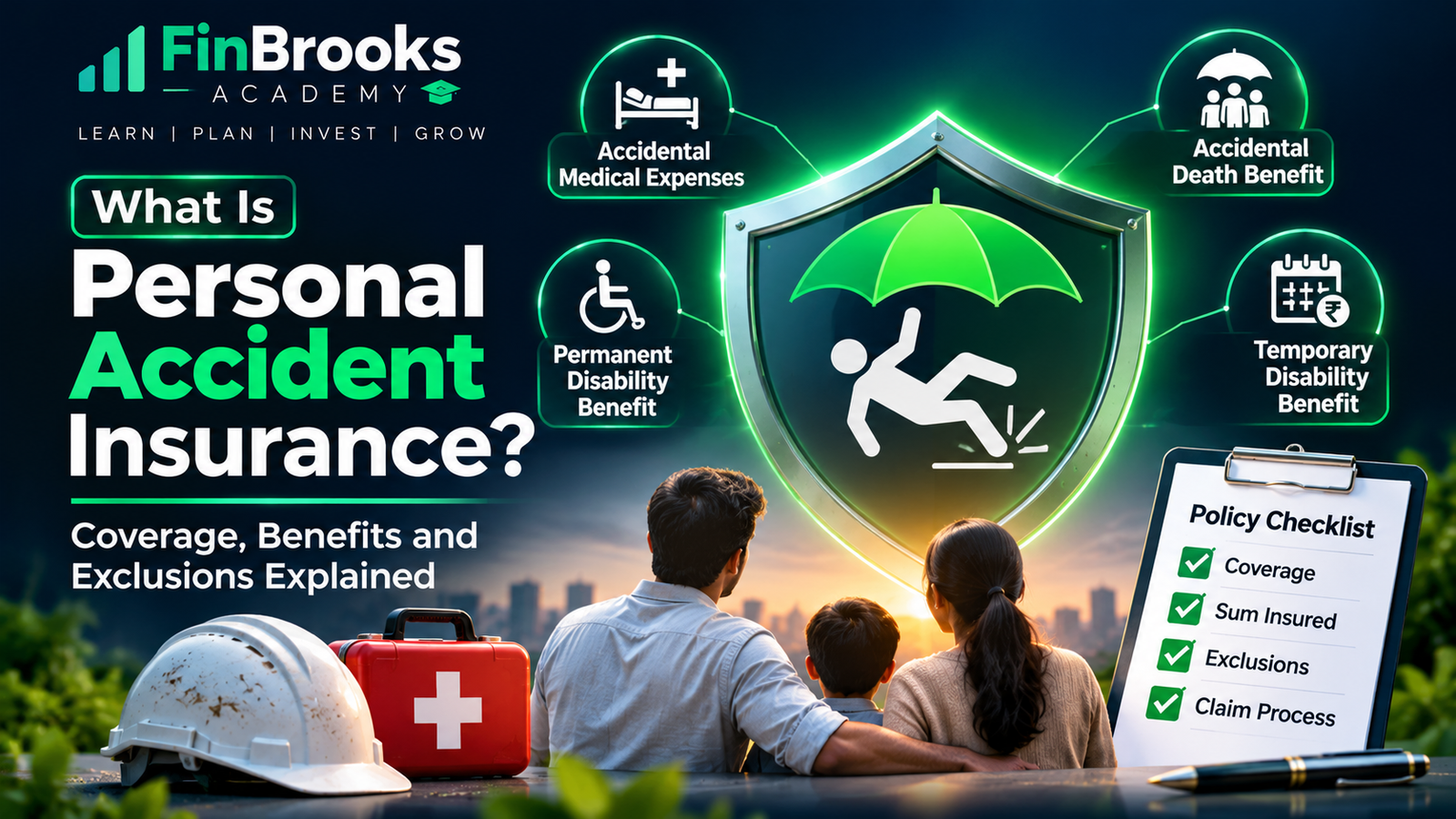
Synopsis: Discover how Personal Accident Insurance protects against specified accidental injuries, disability and death. Learn about coverage, exclusions, benefits and how to choose suitable protection.
Understanding Personal Accident Insurance
An unexpected accident can affect more than just physical health. It may lead to hospital expenses, temporary loss of income, permanent disability or, in severe cases, loss of life.
Personal Accident Insurance is designed to provide financial protection against specified consequences of accidental injuries. It can help individuals and families manage financial uncertainty when an accident affects their ability to work or earn.
Understanding how this insurance works, what it covers and where its limitations apply can help individuals make better financial protection decisions.
What Is Personal Accident Insurance?
Personal Accident Insurance is a type of insurance policy that provides financial benefits when an insured person suffers specified injuries, disability or death due to an accident covered under the policy.
The benefits depend on the policy terms, insured amount, nature of the injury and applicable exclusions.
Unlike health insurance, which primarily covers eligible medical expenses, personal accident insurance generally provides predefined benefits for specified accidental events.
For example, if an insured person suffers a covered permanent disability following an accident, the insurer may pay a benefit according to the policy’s terms and disability schedule.
What Does Personal Accident Insurance Cover?
Coverage varies between insurers and plans. Common benefits may include the following.
Accidental Death Benefit
If the insured person dies due to an accident covered by the policy, the nominee or beneficiary may receive the insured benefit, subject to the policy conditions.
This amount can help the family manage financial responsibilities such as household expenses, outstanding obligations and other financial commitments.
Permanent Total Disability
Permanent total disability refers to a severe accidental injury that results in a permanent inability to perform specified activities or work, as defined by the policy.
Depending on the policy, the insurer may pay the full insured benefit or the amount specified in its disability schedule.
Permanent Partial Disability
Some accidents may result in permanent but partial loss of physical function.
For example, an accident could cause the permanent loss of function of a particular limb or body part. The policy may provide a percentage of the insured amount based on the applicable disability schedule.
Temporary Total Disability
Certain policies offer benefits when an accident temporarily prevents the insured person from performing their regular occupation.
This benefit may provide a weekly or periodic payment for a specified period, subject to the policy’s conditions and limits.
Accidental Medical Expenses
Some plans may also offer reimbursement or coverage for eligible medical expenses resulting from an accident.
However, this benefit is not included in every personal accident policy. The insured should check whether medical expenses are covered separately and understand the applicable limits.
What Is Not Covered Under Personal Accident Insurance?
Personal Accident Insurance does not cover every injury or medical condition. Exclusions vary between insurers and policies.
Common exclusions or restricted circumstances may include:
- Injuries arising from intentional self-harm.
- Accidents occurring while committing certain illegal activities.
- Injuries associated with intoxication, where excluded under the policy.
- Certain hazardous sports or high-risk activities unless specifically covered.
- Illnesses or medical conditions that are not accidental injuries.
- Events specifically excluded under the policy wording.
The exact exclusions should always be checked in the policy document. Do not assume that every accident-related expense or injury will qualify for a claim.
Personal Accident Insurance vs Health Insurance
Although both policies can help protect individuals financially, their primary purposes are different.
Personal Accident Insurance
Personal Accident Insurance focuses on specified consequences of accidental injuries, including accidental death and disability benefits.
Depending on the policy, it may provide a predefined lump-sum or periodic benefit.
Health Insurance
Health Insurance primarily helps cover eligible medical and hospitalisation expenses arising from covered illnesses, injuries and other insured medical conditions.
The coverage depends on the sum insured, waiting periods, exclusions, sub-limits and other policy conditions.
Why Are Both Important?
Health Insurance and Personal Accident Insurance address different financial risks.
A person may have health insurance for eligible hospital expenses but still face income-related difficulties after an accident causes long-term disability.
Personal Accident Insurance may provide an additional financial benefit in such circumstances, subject to the selected coverage.
Neither policy should automatically be treated as a complete replacement for the other.
Who Should Consider Personal Accident Insurance?
Personal Accident Insurance may be useful for people whose financial responsibilities or income could be significantly affected by an accident.
Salaried Employees
Employees who depend on their monthly salary may consider accident-related disability benefits as an additional layer of financial protection.
Self-Employed Professionals
Business owners, consultants and freelancers may experience financial pressure if an accident temporarily or permanently affects their ability to work.
People Who Travel Frequently
Individuals who regularly travel for work or personal reasons may consider the accident-related risks associated with their lifestyle. They should check geographical coverage and any travel-related exclusions.
Primary Earners in a Family
If several family members depend on one person’s income, an accident that affects the primary earner can create financial difficulties.
Accidental death and disability benefits may help provide additional financial support to the household.
How Much Personal Accident Insurance Coverage Do You Need?
The appropriate level of coverage depends on income, financial responsibilities, existing insurance and the family’s financial needs.
There is no single insured amount that is suitable for everyone.
Before selecting a policy, consider the following factors.
Monthly Income
Evaluate how much income your family depends on and how long it may need financial support if you cannot work.
Outstanding Loans
Consider home loans, personal loans, vehicle loans and other financial obligations that may continue even if an accident affects your income.
Family Responsibilities
Consider the number of dependants, household expenses, children’s education and other long-term commitments.
Existing Insurance
Review any personal accident benefits already available through employer insurance, standalone policies or other eligible arrangements. Avoid assuming that every existing benefit provides identical coverage.
Policy Benefits and Limits
Compare accidental death, permanent disability, temporary disability and additional benefits. A larger sum insured is not necessarily better if important coverage conditions are unsuitable.
How to Choose the Right Personal Accident Insurance Policy
Choosing a policy should involve more than comparing the premium.
1. Review the Disability Benefit Schedule
Check how the insurer defines permanent total and permanent partial disability. Understand how benefit percentages are calculated.
2. Check Temporary Disability Benefits
If your income depends on your ability to work, review whether the policy provides temporary disability benefits and how long payments may continue.
3. Understand the Exclusions
Read the policy wording carefully, particularly exclusions related to activities, occupation, intoxication and specific types of accidents.
4. Compare the Insured Amount
Select coverage after considering your income, dependants, liabilities and existing protection.
5. Examine Claim Conditions
Understand the documentation required, reporting deadlines, medical certification requirements and claim submission process.
6. Compare Premiums and Benefits
Compare the actual benefits offered rather than selecting a policy solely because it has the lowest premium.
How to Make a Personal Accident Insurance Claim
The claim process depends on the insurer and the nature of the accident. However, the following steps are commonly relevant.
- Inform the insurer within the prescribed reporting period.
- Obtain the necessary medical treatment and preserve relevant medical records.
- Collect supporting documents such as accident reports, hospital records and disability certificates, where applicable.
- Complete the insurer’s claim form and submit the required documents.
- Respond to any additional information requests from the insurer.
- Review the claim decision and settlement details.
For accidental death claims, the nominee or legal claimant may need to provide additional documentation, such as a death certificate and other records required by the insurer.
Always follow the claim instructions and deadlines stated in the policy.
Common Mistakes to Avoid
When purchasing personal accident insurance, individuals should avoid these mistakes:
- Assuming it provides the same coverage as health insurance.
- Ignoring the disability benefit schedule.
- Choosing coverage only on the basis of a low premium.
- Overlooking exclusions and claim conditions.
- Not checking whether temporary disability benefits are included.
- Ignoring existing accident coverage through an employer or another policy.
- Providing incomplete or inaccurate information when purchasing insurance.
Reading the policy wording before buying can help avoid misunderstandings during a claim.
Conclusion
Personal Accident Insurance can provide an additional layer of financial protection against specified accidental injuries, disability and death.
It is particularly worth considering for individuals whose families depend on their income or whose financial responsibilities could become difficult to manage after a serious accident.
However, the value of a policy depends on its coverage, exclusions, disability benefits and claim conditions. Individuals should compare these features carefully and select protection that matches their financial responsibilities.
A well-planned financial protection strategy should consider health insurance, life insurance, personal accident coverage and an adequate emergency fund as complementary elements.
Disclaimer: This article is for educational purposes only and does not constitute insurance or financial advice. Coverage, exclusions, eligibility and claim benefits depend on the insurer’s policy wording.
Stay Ahead of the Market 📈
Subscribe to our weekly newsletter
Get your weekly market summary from FinBrooks Insights and smart financial lessons from FinBrooks Academy delivered straight to your inbox every weekend!