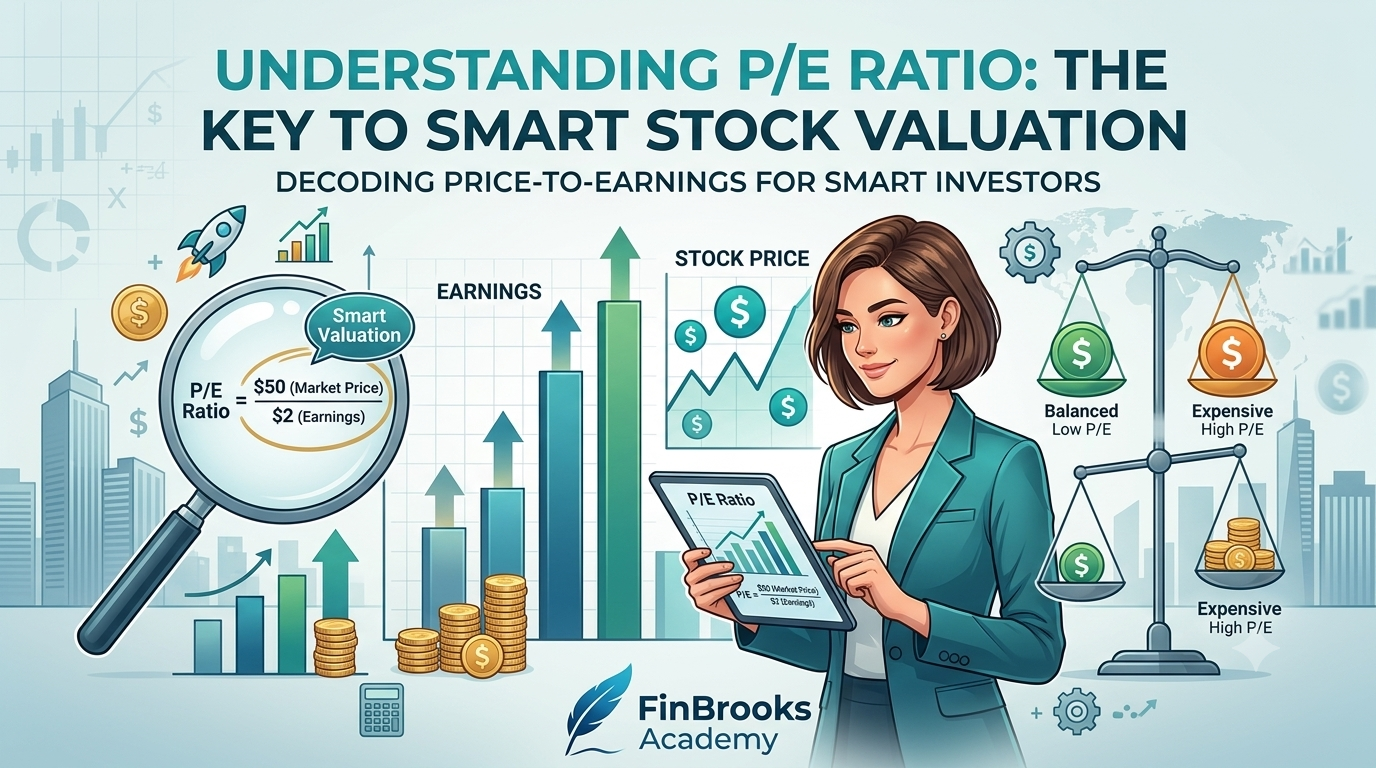
Decoding the Price-to-Earnings Ratio: How to Tell if a Stock is Too Expensive
Imagine walking into a grocery store to buy apples. One stall sells them for $2 a pound, and another sells them for $5 a pound. To know which is the better deal, you need to look at the quality, right?
The stock market works the same way. You cannot tell if a stock is cheap or expensive just by looking at its share price. A $500 stock might actually be a massive bargain, while a $5 stock could be terribly overpriced.
To figure out the real truth, investors use a crucial tool called the P/E Ratio (Price-to-Earnings Ratio). Let’s break down exactly what it means in plain English.
What Exactly is the P/E Ratio?
The P/E ratio is a metric that helps you understand how much the stock market is willing to pay today for a company’s earnings.
Think of it as a value meter: It tells you how many dollars you need to invest to earn exactly $1 of that company’s profit.
📊 THE P/E RATIO FORMULA
Here is the simple math behind it:
- P/E Ratio = Market Price per Share ÷ Earnings per Share (EPS)
🍕 A Simple Example: The Pizza Shop Duel
Let’s see how this works with two competing pizza chains listed on the stock market:
- Pizza Company A:
- Stock Price: $100
- Earnings per Share (EPS): $5
- Calculation: $100 ÷ $5 = 20
- P/E Ratio = 20 (You pay $20 for every $1 of profit)
- Pizza Company B:
- Stock Price: $60
- Earnings per Share (EPS): $2
- Calculation: $60 ÷ $2 = 30
- P/E Ratio = 30 (You pay $30 for every $1 of profit)
The Verdict: Even though Company B has a lower share price ($60 vs $100), Company A is actually cheaper because its P/E ratio is lower!
High P/E vs. Low P/E: What’s the Difference?
When you look up a stock on your brokerage app, you will immediately see its P/E ratio. Here is how to interpret that number:
1. What a High P/E Means (Usually above 25)
A high P/E ratio means investors are expecting high growth from the company in the future. They are willing to pay a premium price today because they believe the company will make massive profits tomorrow (e.g., Tech and AI stocks).
- The Risk: If the company fails to grow as fast as expected, the stock price can crash hard.
2. What a Low P/E Means (Usually below 15)
A low P/E ratio could mean two things: either the company is undervalued (a hidden gem), or the company is in trouble and its growth has stopped completely. Older, stable industries like banks or utility companies often have lower P/E ratios.
Quick Summary: P/E Ratio Cheat Sheet
Aap WordPress me ek Table Block lekar is data ko asaani se daal sakte hain:
| Feature | High P/E Ratio | Low P/E Ratio |
| Market Sentiment | Growth Stock / Premium | Value Stock / Discount |
| Investor Expectation | Expecting massive future growth | Expecting slow, steady growth |
| Example Industries | Technology, Electric Vehicles, AI | Utilities, Banking, Energy |
| Main Risk | Price might crash if growth slows | Could be a failing business trap |
FinBrooks Reality Check 💡
Never judge a stock using the P/E ratio by itself!
A P/E ratio is only useful when you compare a company against its direct competitors or the industry average. Comparing the P/E of a tech stock (like Microsoft) to the P/E of a grocery store chain (like Walmart) is completely useless. Always compare apples to apples!
Stay Ahead of the Market 📈
Subscribe to our weekly newsletter
Get your weekly market summary from FinBrooks Insights and smart financial lessons from FinBrooks Academy delivered straight to your inbox every weekend!