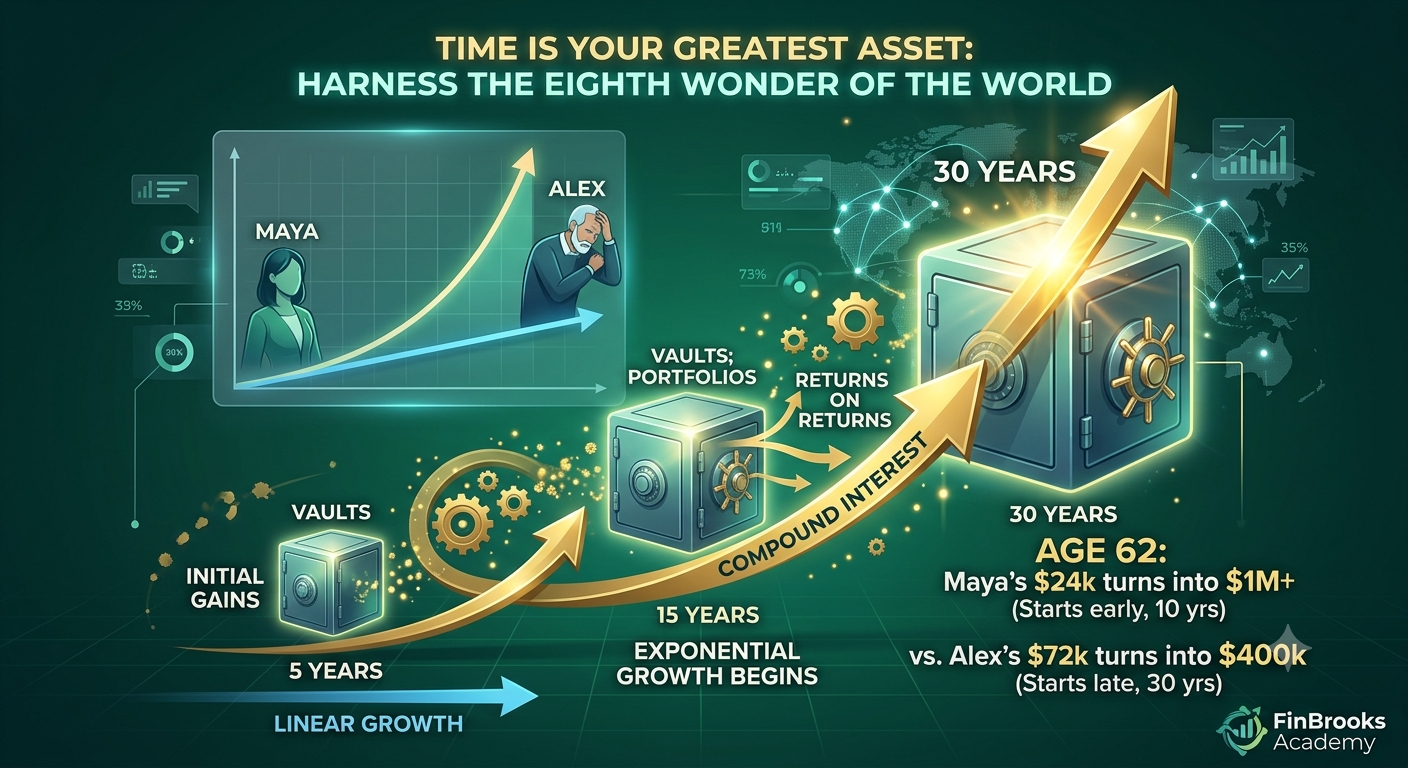
Exponential vs. Linear Growth: Why Starting Just 5 Years Early Can Double Your Net Worth
Albert Einstein famously called compound interest the “eighth wonder of the world”—he who understands it, earns it; he who doesn’t, pays it. Yet, most people treat saving money as a linear equation: save a dollar today, have a dollar tomorrow.
In long-term investing, money does not grow linearly; it grows exponentially. Your initial principal earns returns, and then those returns earn returns of their own. Let us break down how compound interest works and why time is your greatest asset in building financial independence.
Simple Interest vs. Compound Interest
To understand the immense power of compounding, consider the difference between simple and compound growth:
- Simple Interest: Interest is calculated only on your original principal amount. If you invest $1,000 at 10% annual simple interest, you earn $100 every single year. After 10 years, you have $2,000.
- Compound Interest: Interest is calculated on your original principal plus all previously accumulated interest. If you invest $1,000 at 10% compound interest, you earn $100 in year one. In year two, you earn 10% on $1,100 ($110). By year 30, that single $1,000 grows to over $17,400 without adding another penny.
The Cost of Waiting: The Early Bird Advantage
The single most critical variable in the compounding equation is not the amount of money you invest, nor the return percentage, it is time.
Consider two investors, Maya and Alex:
- Maya starts investing $200 per month at age 22. She stops completely at age 32 (investing for just 10 years, total $24,000 invested).
- Alex waits until age 32 to start. He invests $200 per month continuously until age 62 (investing for 30 years, total $72,000 invested).
Assuming an average 10% annual return, by age 62, Maya will have more wealth than Alex, despite investing one-third of the money. Her extra 10 years of early compounding created a momentum that Alex could never catch up to.
Compounding Growth Over Time
| Years Invested | Total Principal ($200/mo) | Portfolio Value (at 10% p.a.) | Gain from Compounding |
| 5 Years | $12,000 | $15,487 | $3,487 |
| 15 Years | $36,000 | $83,587 | $47,587 |
| 25 Years | $60,000 | $265,366 | $205,366 |
| 35 Years | $84,000 | $758,970 | $674,970 |
FinBrooks Reality Check
You do not need a massive salary to build substantial wealth; you simply need to start early and remain consistent.
The best time to start investing was 10 years ago; the second best time is today. Automate your monthly contributions into low-cost index funds immediately, give your money time to compound, and let math do the heavy lifting for your financial future.
Stay Ahead of the Market 📈
Subscribe to our weekly newsletter
Get your weekly market summary from FinBrooks Insights and smart financial lessons from FinBrooks Academy delivered straight to your inbox every weekend!